Understanding Esophageal Atresia Repair
Esophageal atresia is a birth defect where the esophagus, the tube that connects the throat to the stomach, doesn’t form correctly. This means the upper part of the esophagus ends in a pouch, preventing food from reaching the stomach. This condition is often diagnosed soon after birth when a newborn struggles to swallow and may cough or choke when fed. Timely intervention by a skilled Neonatal Surgeon is critical for a child’s survival and long-term health. The goal of esophageal atresia repair is to surgically connect the two ends of the esophagus, allowing for normal feeding and digestion.
The Surgical Process: A Multidisciplinary Approach
The treatment for esophageal atresia is a complex surgical procedure performed by a specialized Child Specialist Surgeon. The process often involves a multidisciplinary team to ensure the best outcome.
- Initial Diagnosis and Stabilization: After diagnosis, the newborn is stabilized to prevent complications like aspiration pneumonia.
- Surgical Repair: The Pediatric Surgeon performs the surgery, which may be an open procedure or a minimally invasive one. The two ends of the esophagus are located and then sewn together to create a continuous passage.
- Advanced Techniques: Depending on the case, a Pediatric Laparoscopic Surgeon or Neonatal Laparoscopic Surgeon may use minimally invasive techniques. A Pediatric Thoracoscopic Surgeon or Neonatal Throscosis Surgeon might also be involved for procedures within the chest cavity.
- Post-Operative Care: The child will be monitored closely in the neonatal intensive care unit (NICU). Feeding is initiated gradually as the surgical site heals.
Beyond Esophageal Atresia: The Scope of Pediatric Surgery
A Pediatric Surgeon‘s expertise extends far beyond esophageal atresia repair. They are specially trained to handle the unique surgical needs of infants and children. Their scope includes a wide range of congenital and acquired conditions:
- Gastrointestinal Surgeries: Procedures like Gastroschisis surgery, Pyloric stenosis surgery, Hirschsprung’s disease surgery, Pediatric fundoplication for GERD, and Pediatric Liver surgeries are routine. They also perform Neonatal Hirschsprung’s disease surgery and Neonatal Omphalocele repair.
- Oncological Surgeries: They are also skilled in removing tumors like Wilms tumor surgery, Neuroblastoma surgery in children, and Teratoma removal in children.
- Urological Procedures: A Pediatric Urologist handles conditions like Hydrocele treatment in children, Undescended testes surgery, Hypospadias surgery in children, and Pediatric kidney stone removal. They are also trained in advanced techniques such as Robotic pyeloplasty in children.
- General Pediatric Surgery: They manage common conditions like Pediatric Hernias Treatment and pediatric appendix Treatment.
- Anorectal Malformations: They are experts in performing Anorectal malformations surgery.
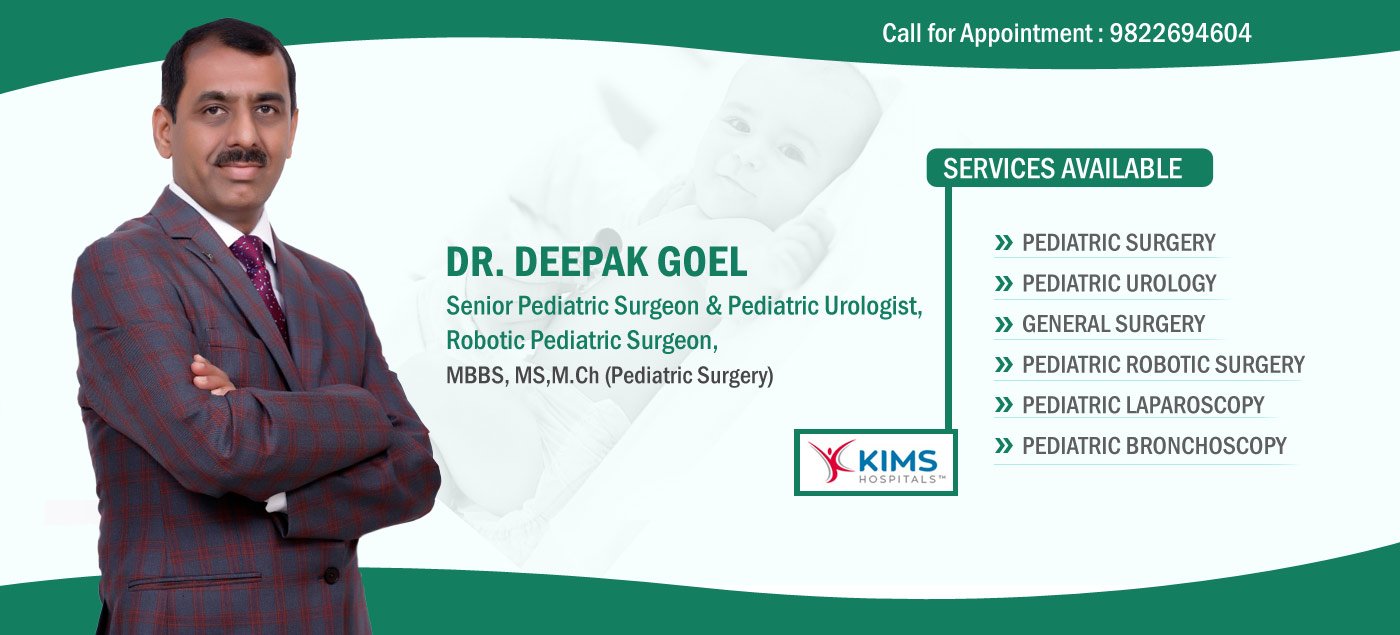
About Dr. Deepak Goel, Best Pediatric Surgeon in Nagpur
Dr. Deepak Goel is a leading Senior Consultant Pediatric Surgeon and Pediatric Urologist in Nagpur. He is known for his expertise and compassionate care for children. Holding an MBBS, MS, and an M.Ch (Pediatric Surgery), Dr. Goel is a highly qualified specialist. As a proficient Robotic Pediatric Surgeon, he utilizes cutting-edge robotic technology for precise and minimally invasive procedures, leading to faster recovery and better outcomes. His practice covers a vast range of pediatric surgeries, including complex congenital anomalies, laparoscopic and thoracoscopic surgeries, and advanced pediatric urological procedures, making him a trusted choice for parents seeking the Best Pediatric Surgeon for their child.